Understanding capacity Measurements:
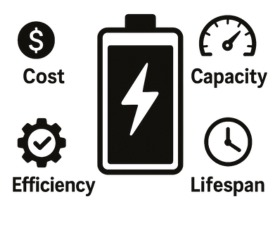
The capacity of a battery represents the total energy it can store.
It is measured in kilowatt-hours (kWh)
Measuring capacity directly in current (A) can be misleading.
Always consider both current and voltage to accurately assess a battery’s energy storage.
Example: 200A battery that is 24V has in fact 4800Wh (4.8Kwh) Capacity
200A battery that is 48V…
Intro: A storage system is a crucial component as it stores all the energy. A high-quality battery, exhibit minimal degradation throughout the years. Additionally, a fast charging battery, ensures maximum harness from the photovoltaic and store it the quickest possible under short intervals of SUN in cloudy days conditions.
Allowed Speed of Charge and Discharge:
Consider…
Low-Frequency Inverters: Low-frequency inverters feature a massive transformer and typically operate at 50 Hz or 60 Hz. They are robust and reliable, designed to operate long-term in areas with poor grid conditions, withstanding fluctuations and supporting all types of loads. Advantages: Unmatched Reliability: Designed for all types of loads and long-term operation. Stable Output: The transformer absorbs…
Before buying solar panels, consider the available space. If you have ample space, the efficiency of the solar panels may not be your top priority.
Most Popular traded tech of Solar Panels
PERC (Passivated Emitter and Rear Cell) Panels
Currently the cheapest option.
Slightly faster degradation rate, considered lower quality.
N-Type Panels
Higher…
1. What is Electricity?
Electricity is the movement of tiny particles called electrons through a conductor (such as wires). Think of it like water flowing through pipes: when electrons move, they create energy that powers our daily lives.
2. Electric Charge
Everything is made up of atoms, which contain protons, neutrons, and electrons:
Protons…
Note: That info is used as a complimentary information for certified professionals
Pre-Installation: Safety & Installation Guide
1. Professional Installers Only
It is recommended that the equipment be installed by trained electricians or certified technicians.
2. Before You Start
Read the manual carefully and follow the manufacturer’s instructions.
3. Choosing the Right Location
…